

Executive Summary
For decades, cybersecurity has been organized around three dominant pillars: endpoint security, network security, and cloud security. These domains have shaped technology categories, vendor ecosystems, and enterprise budgets. They have matured into multi-billion-dollar markets, each responding to successive waves of digital transformation. However, a tectonic shift is underway.
With AI agents and Model Context Protocol (MCP) servers proliferating across enterprises, API traffic has exploded in both volume and importance. APIs are no longer just backend plumbing; they are production-critical, customer-facing, and increasingly the primary attack surface. Yet, APIs remain poorly inventoried, weakly governed, and inadequately protected by the existing three pillars of cybersecurity.
The rise of APIs as the connective tissue of modern business creates a new class of risk that existing categories cannot contain.
AI agents and API security are no longer subsets or features within these pillars. Agentic AI security is fast emerging as the fourth pillar of cybersecurity: a standalone discipline essential for protecting the digital enterprise of the AI era.
The Three Pillars of Cybersecurity Today
Endpoint Security
The first pillar emerged in the late 1990s with the explosion of laptops and mobile devices. Antivirus and anti-malware evolved into endpoint detection and response (EDR) and now extended detection and response (XDR). Endpoint security protects the edge where humans interact with machines.
Network Security
The second pillar grew in parallel. Firewalls, intrusion detection systems (IDS/IPS), and secure web gateways became the backbone of perimeter defense. Even as the perimeter blurred, network security remained essential for monitoring, segmenting, and controlling data in motion.
Cloud Security
The third pillar was born from SaaS adoption and cloud infrastructure. Cloud security solutions now safeguard workloads, data, and access across AWS, Azure, Google Cloud, and SaaS ecosystems. Cloud security platforms provide visibility and control over ephemeral, API-driven infrastructure.
Together, these pillars created the foundation of modern cybersecurity. But they share a blind spot: APIs.
What is Agentic AI Security?
Agentic AI Security is a new cybersecurity category designed to protect autonomous AI agents that independently make decisions, initiate workflows, and interact with systems through continuous API calls. Because every AI agent depends on APIs to function, securing those APIs is the foundation of agentic security. Legacy tools like firewalls and API gateways were built for predictable human behavior and cannot handle the dynamic, machine-driven patterns these agents generate. As autonomous agents are rapidly deployed across industries, a purpose-built security approach is now essential. Agentic AI Security is considered the fourth pillar of the modern cybersecurity market.
Traditional Focus of the Three Existing Cybersecurity Pillars
1. Endpoint Security
- Originated with antivirus, evolved into EDR/XDR.
- Focus: securing laptops, servers, mobile devices from malware, ransomware, and insider threats.
- Representative vendors: CrowdStrike, SentinelOne, Microsoft Defender.
2. Network Security
- Centered around firewalls, IDS/IPS, and intrusion detection.
- Focus: monitoring and controlling data flow across on-premises and cloud networks.
- Representative vendors: Palo Alto Networks, Fortinet, Cisco.
3. Cloud Security
- Emerged as enterprises shifted workloads to AWS, Azure, and GCP.
- Focus: misconfigurations, identity, workload protection, container/Kubernetes security.
- Representative vendors: Wiz, Lacework, Orca, Prisma Cloud (Palo Alto Networks).
These three pillars have served enterprises well, but they were not designed to address the unique challenges of APIs powering AI-driven architectures.
The Rise of APIs and the Blind Spot of Traditional Security
APIs now power nearly every aspect of digital transformation:
- Mobile and web applications
- SaaS integrations
- Microservices architectures
- Cloud-native infrastructure
- AI and machine learning pipelines
Unlike endpoints, networks, or clouds, APIs are not a discrete object or location to secure. They are interfaces that are dynamic, ephemeral, and proliferating faster than organizations can track.
Analyst data shows that APIs now account for over 80% of web traffic. Yet most organizations cannot answer fundamental questions:
- How many APIs do we have?
- Which ones are exposed externally?
- What sensitive data do they expose?
- Are they compliant with policy?
- Are they under active attack?
Traditional pillars fall short:
- Endpoint tools don’t see API traffic.
- Network security can’t parse encrypted, JSON-based payloads.
- Cloud security platforms may inventory APIs but rarely enforce runtime protection.
The result: APIs have become the largest unprotected attack surface in the enterprise.
Why Agentic AI Security Demands a New Approach
1. APIs are the New Business Logic
Every mobile app, SaaS platform, and AI agent action is API-driven. APIs aren’t just data conduits, they execute core business processes: payments, identity verification, supply chain execution, medical record access.
2. AI Agents and MCP Servers Depend on APIs
- AI agents reason and act by calling APIs.
- MCP servers broker requests across dozens of APIs at enterprise scale.
- These new digital actors massively expand the attack surface, generating unpredictable, high-volume API traffic.
3. Invisible to Current Security Stacks
- Endpoints do not monitor machine-to-machine traffic.
- Networks see encrypted flows but not application-layer API logic.
- Cloud security focuses on configurations, not runtime API abuse.
- Result: APIs, especially those invoked by AI agents, exist in a “security blind spot.”
4. Adversaries Are Already Exploiting APIs
- OWASP API Top 10 highlights unique risks like broken object-level authorization.
- High-profile breaches (Optus, T-Mobile, Peloton, etc.) were API-driven.
- Attackers are now targeting AI workflows directly through exposed APIs.
5. New Threat Vectors
Attackers no longer need to exploit human users. They can exploit AI agents and their API calls:
- Prompt injection → API abuse
- MCP manipulation → data exfiltration
- Agent chaining → privilege escalation
The three existing pillars have no visibility into this traffic. Without API security as a core discipline, organizations will have no control over the digital nervous system of their AI infrastructure.
The Case for Agentic AI Security as the Fourth Pillar
The history of cybersecurity shows a clear pattern: each technology revolution creates a new security category.
- The rise of personal computing → endpoint security.
- The rise of enterprise networks → network security.
- The rise of cloud computing → cloud security.
Today, the rise of API-first digital ecosystems and AI agents is driving the need for a new security pillar. Agentic AI security is not a niche or subcategory. It is the logical fourth pillar of the cybersecurity market.
Just as no enterprise would deploy workloads in the cloud without a dedicated cloud security program, no enterprise can responsibly deploy AI agents or run modern digital businesses without API security as a core foundation.
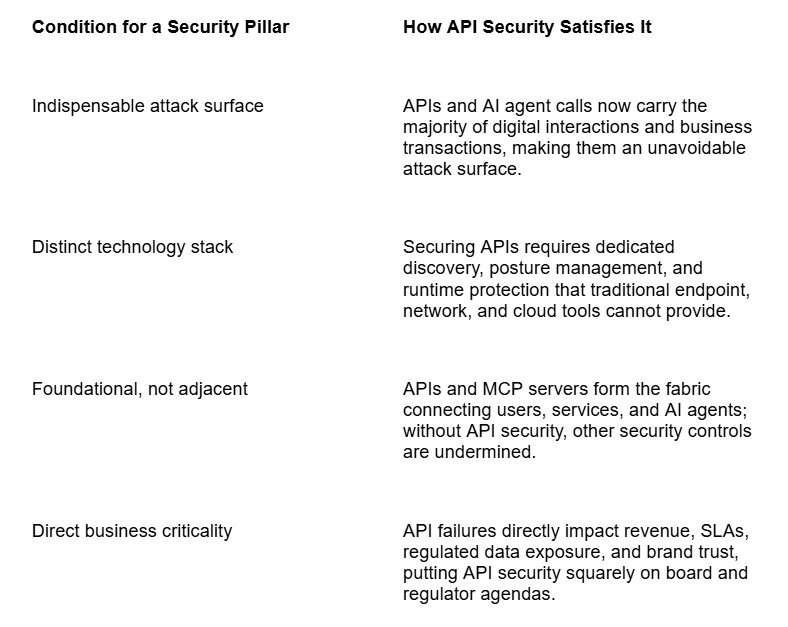
To join endpoint, network, and cloud as a pillar, a discipline must meet four conditions:
- Indispensable Attack Surface: APIs now power 80%+ of traffic and all AI agents. Enterprises often have 10–20x more APIs than traditional applications, many undocumented (“shadow APIs”).
- Distinct Technology Stack: API security requires unique discovery, posture governance, and runtime protection that existing tools cannot provide.
- Foundational, Not Adjacent: Just as cloud security couldn’t be solved by extending network controls, API security requires a distinct category with purpose-built tooling.
- Business Criticality: APIs are revenue enablers and compliance risks simultaneously.
Taken together, these four conditions confirm that API security is not an adjacent feature but a full-fledged fourth pillar alongside endpoint, network, and cloud.
Comparative Table: Why APIs Require a New Pillar
Why it Matters
For CISOs
Just as endpoint, network, and cloud each required new budgets, teams, and strategies, API security must now be elevated as a board-level priority. Governance is the foundation that enables organizations to move security from a purely technical function to a strategic business enabler, ensuring the authority, accountability, and alignment needed to manage risk at an organizational level. Strong governance frameworks provide security teams the structure to enforce policies, demonstrate compliance, and communicate security posture to boards and executives in terms that drive informed decision-making.
For Vendors
The market will consolidate around platforms that provide holistic API security—discovery, governance, and protection—rather than point features in WAFs or gateways.
For Analysts and Policymakers
Frameworks like NIST and MITRE must evolve to recognize API security as a distinct category, particularly in the context of AI-driven architectures.
What Agentic Security Solutions Should Cover
Securing the agentic action layer requires three things that most AI security tools are not built to provide.
- Start by identifying the APIs and MCP servers your agents are actually connected to. Ignore assumptions or what your developer reports. Focus on what is truly running. Include rogue deployments, shadow MCPs, and any endpoints that were never formally registered.
- Second, you need a behavioral baseline. What does normal look like for this agent? Which APIs does it call, at what frequency, with what kind of payload? Anomaly detection without a baseline is just noise.
- Third, you need runtime visibility across your actual infrastructure: Kubernetes, load balancers, API gateways, legacy systems, and modern cloud services. Agents do not respect your technology stack preferences. They call whatever they have access to. Your monitoring needs to cover all of it.
For security practitioners trying to get ahead of agentic risk, the architecture points to a clear set of requirements:
- Visibility Across All Three Layers: Security cannot be siloed into just the model or just the perimeter. You need to see the full path from the LLM prompt to the final API call.
- Complete Inventory: You must maintain an inventory of all agents, MCP servers, and APIs operating in the environment. You cannot secure what you cannot see.
- Relationship Mapping: It is essential to understand the "line of credit" each agent has. Which agents connect to which MCP servers? Which MCP servers call which APIs? What data and systems do those APIs access?
- Continuous Behavioral Monitoring: Monitoring must span the full stack, not just the edge. This requires analyzing the intent behind API calls to identify when an agent is being manipulated or is malfunctioning.
- Contextual Risk Assessment: Risk should be assessed based on what each agent can actually do (its potential impact on the action layer), not merely on its existence.
The agentic stack is not especially complicated once you see it clearly. But most security frameworks and tools were built before it existed, and they reflect that. Closing the gap starts with understanding the architecture, all three layers of it, and building a security approach that covers the full picture.
- See Everything: You cannot protect connections you do not know exist. Salt automatically discovers every MCP server, every AI-to-data bridge, and every shadow agent a developer stood up without telling security. Continuous discovery is the only foundation for AI governance.
- Enforce Machine-Speed Governance: AI agents should not have all-access passes. Salt enforces adaptive governance for machine-to-machine identities, ensuring an agent can call only the specific APIs it needs. This prevents "confused deputies" from ever reaching sensitive data.
- Monitor Intent, Not Just Traffic: Traditional tools cannot read conversation intent. Salt’s patented Intent Analysis establishes a baseline of what normal looks like for each agent. An agent that typically processes ten emails suddenly summarizes thousands? That is a behavioral anomaly. Salt flags and blocks these logic-based threats in real-time.
Conclusion
Cybersecurity has always evolved with the architecture of computing. Endpoints, networks, and clouds each demanded their own discipline as organizations digitized. Today, APIs, especially in the age of AI agents and MCP servers, are that architecture. Cybersecurity must adapt to the era of API-driven AI. APIs have become the operating system of modern business—the entry point to data, logic, and digital value. AI agents amplify this reliance, expanding both the opportunity and the risk.
To meet this challenge, enterprises must recognize Agentic AI security as the Fourth Pillar of Cybersecurity, on par with endpoint, network, and cloud security. Vendors, analysts, and boards alike must shift their frameworks to ensure API protection is treated not as an add-on, but as a category-defining requirement for the next decade.
If you want to learn more about Salt and how we can help you, please contact us or schedule a demo. You can also get a free Agentic AI Assessment from Salt Security's research team and learn what attackers already know.