

Over the past few weeks, the topic of tariffs has dominated headlines internationally. These trade measures have triggered global economic volatility, with the European Union (EU) pausing its retaliatory tariffs to allow room for negotiation. While the immediate focus is on economic ramifications, it's crucial to recognize the less visible, yet significant, impact these tariffs can have on cybersecurity infrastructures, especially in the realm of API security. Although tariffs affect trade flows and expenses, it is the immediate business changes they demand, often related to critical digital infrastructure, that inadvertently open up new channels for cyber risk, especially via APIs.
Tariffs Trigger Supply Chain Whiplash — APIs Get Caught in the Crossfire
When tariffs hit foreign-made technology — hardware, software, or cloud services — organizations scramble to adapt. That means switching vendors, relocating data processing, or quickly rewiring logistics workflows. What does that look like in practice? Tearing out old API connections and deploying new ones at lightning speed.
The problem: These rapid changes often bypass the rigorous governance and security testing typically applied to production code. Temporary endpoints become permanent. Testing environments get promoted to live. Shadow APIs multiply — and so do the risks.
Example: A global retailer replatforms a logistics provider to dodge new tariffs, but months later, deprecated APIs to the previous provider are still live and unmonitored, leaking sensitive metadata.
Disrupted Vendors and Broken APIs = Open Doors for Attackers
Tariffs can disrupt an organization's third-party vendors, especially those in affected regions. When these vendors go offline or falter, APIs may break, but they don’t always fail gracefully. Applications start endlessly retrying, logging sensitive errors, or falling back to insecure default modes. Attackers notice. A broken or unstable API is often the weakest link—one they’ll probe for easy access.
Example: An overseas AI vendor hit by tariffs sees their API uptime drop. Client applications, desperate for continuity, disable authentication checks — unwittingly opening the door to attackers.
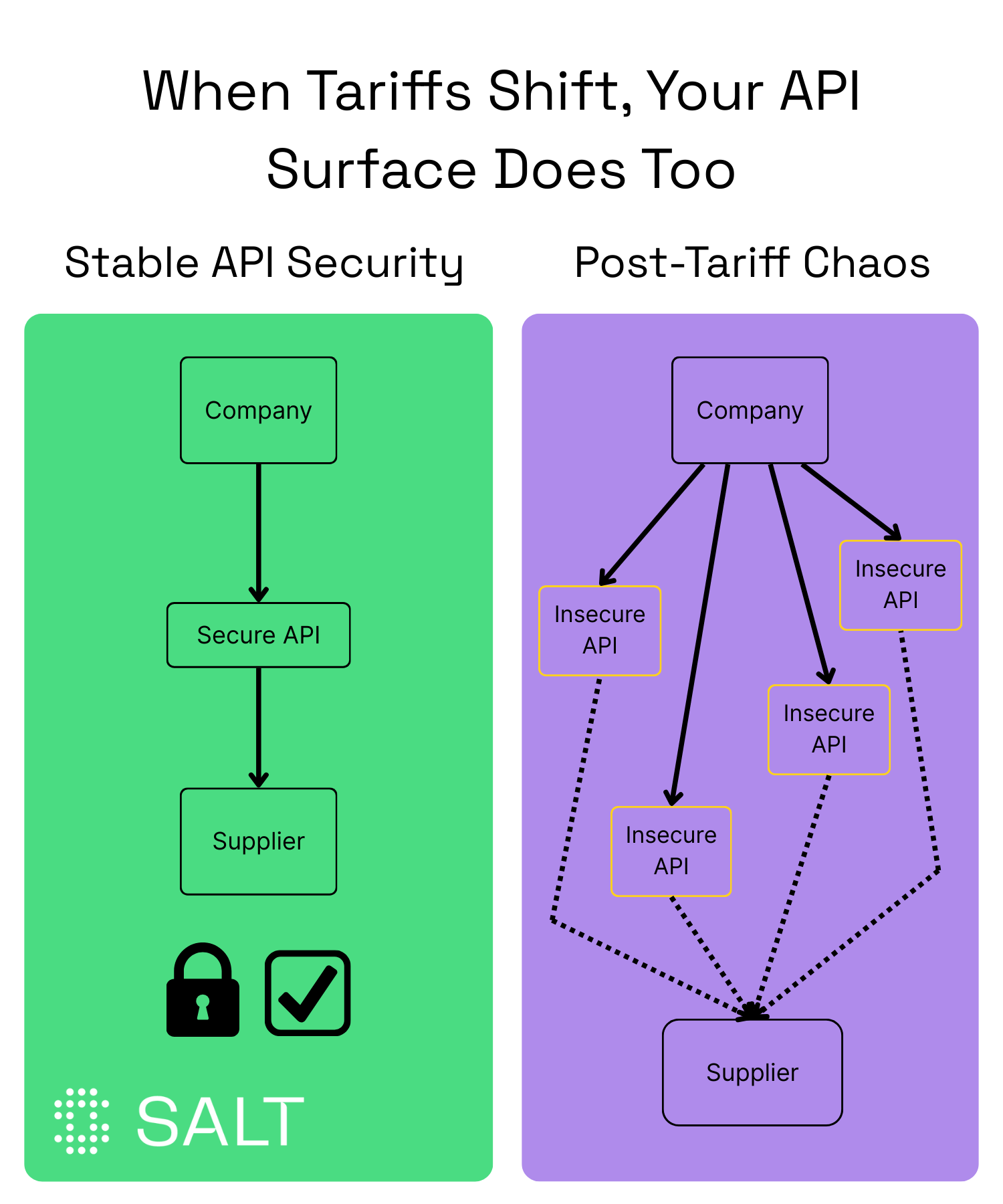
Fragmentation Erodes API Visibility and Security
Driven by the need to comply with trade restrictions or localize data, trade restrictions often force businesses to regionalize operations, spinning up new cloud regions and partner-specific APIs. Every one of these moves expands an organization's API surface area—usually without centralized oversight or consistent security policies.
Example: A SaaS provider shifts data storage for EU customers in response to tariff changes. The new instance includes an outdated internal API with known vulnerabilities that was never properly secured—and becomes the entry point for a data breach or lateral movement within the network.
Sanctions Obscure Dependency Chains — And Create Compliance Nightmares
Sanctions can force organizations to cut off vendors. But their code — or their APIs — may persist, hidden deep within their integrations. These “ghost dependencies” are notoriously difficult to find and even harder to secure. If exploited, they don’t just compromise data—they can create regulatory and compliance liabilities.
Example: A fintech platform continues using a payment microservice that unknowingly routes transaction data through a blacklisted partner via a hidden API call. The API itself becomes the compliance liability, potentially leading to significant fines and reputational damage.
Budget Squeeze: Security Can’t Be an Afterthought
If tariffs significantly raise operational costs, already tight security budgets may face further strain—especially if API security is still misunderstood or underfunded. Proactive protection takes a back seat, opening the door to breaches and compliance failures.
What Should CISOs Do About It?
Tariffs and trade disruptions are more than an economic story — they’re a cybersecurity story as well. APIs are at the heart of digital transformation and modern business, but they’re also one of the fastest-growing attack surfaces.
Here’s how to defend your environment:
- Continuously discover every API — including zombie and shadow APIs potentially left behind during rushed, tariff-driven transitions.
- Map your third-party API exposure, especially in regions affected by trade volatility or sanctions.
- Apply posture governance widely to ensure every new API, even those deployed rapidly in response to trade changes, meets security and compliance requirements before it goes live.
- Monitor API behavior in real time to catch broken integrations, fallback modes, and traffic anomalies before attackers do.
- Advocate for resilient vendor strategies and dedicated API security funding, framing it as essential mitigation against business risks amplified by global trade volatility, even when budgets are tight.
Platforms like Salt Security can help by automating API discovery, mapping dependencies, and alerting you to risky changes before attackers can exploit them.
Trade Policy Is Now a Security Issue
Tariffs and trade wars were once the territory of economists. Today, every shift in global policy has the potential to reshape an organization’s API landscape — and open new doors for attackers. In a fragmented world, visibility is power. If security teams are not watching how trade disruptions impact APIs, organizations are missing one of the fastest-growing threats within their stack.
Stay informed and ensure API security is a key part of your strategy as global trade dynamics continue to evolve.
If you want to learn more about Salt and how we can help you on your API Security journey through discovery, posture governance, and run-time threat protection, please contact us, schedule a demo, or check out our website.