
Now available
Stop reviewing AI code.
Start governing it.
Salt Code is the first solution that enforces your security policies inside every AI coding assistant your developers use. Cursor, GitHub Copilot, Claude, and the rest now generate compliant code by default. From the first prompt through runtime.
The Problem AI writes code at machine speed. Your security can’t keep up.
AI coding assistants are generating APIs, MCP integrations, agent tools, and application logic faster than your security team can review them. And none of them are trained on your internal security standards, industry frameworks, or regulatory requirements.

Insecure patterns ship without anyone noticing
Developers prompt their way to working code. The AI delivers fast. Your policies never enter the conversation, and neither does anyone qualified to enforce them.

Security finds issues too late in the pipeline
SAST and DAST tools catch problems downstream. By then the code is committed, reviewed, and queued for deployment. Every fix is a rewrite. Every rewrite is a delay.

Policy enforcement is manual and inconsistent
Your policies live in PDFs, wikis, and tribal knowledge. The AI building your software has read none of them. Compliance becomes a coin flip on every commit.
The Shift
The goal is no longer to review code after it is written. It is to make sure every line of AI-generated code is compliant the moment it is created.
How it works Policy enforcement, end to end.
Salt Code connects the Salt Posture Governance Engine to the tools developers already use, then carries policy enforcement across every stage of the lifecycle, from prompt to production.
Salt Code gives security teams one policy model for how agentic systems are built, configured, and validated in production across APIs, MCP integrations, and agents.
Identify every API, MCP server, and AI agent integration across your code repositories and cloud environments. See what is being built and how systems are connected before risk has a chance to hide.
Salt translates your security policies into rules that guide AI coding assistants in real time. The output is policy compliant by default. No developer has to ask for it, and no security reviewer has to chase it.
Policy validation extends into CI/CD workflows. Violations are blocked before they reach production. Downstream SAST and DAST findings drop dramatically because the issues were never written in the first place.
Continuously monitor behavior across APIs, MCP integrations, and agents in production. Detect policy violations, posture gaps, and anomalous activity as systems actually run, not as they were supposed to run on paper.
Runtime findings are translated into actionable fixes and fed back into developer workflows and the AI assistants themselves. The baseline quality of your AI-generated code improves with every cycle.
The product One console. Every policy. Every assistant.
Define policy once. See active developers, policy invocations across MCP tool calls, top guidance categories applied, and every coding context pack at a glance. From OWASP API Top 10 to MCP Security Top 10 to your own custom rules.
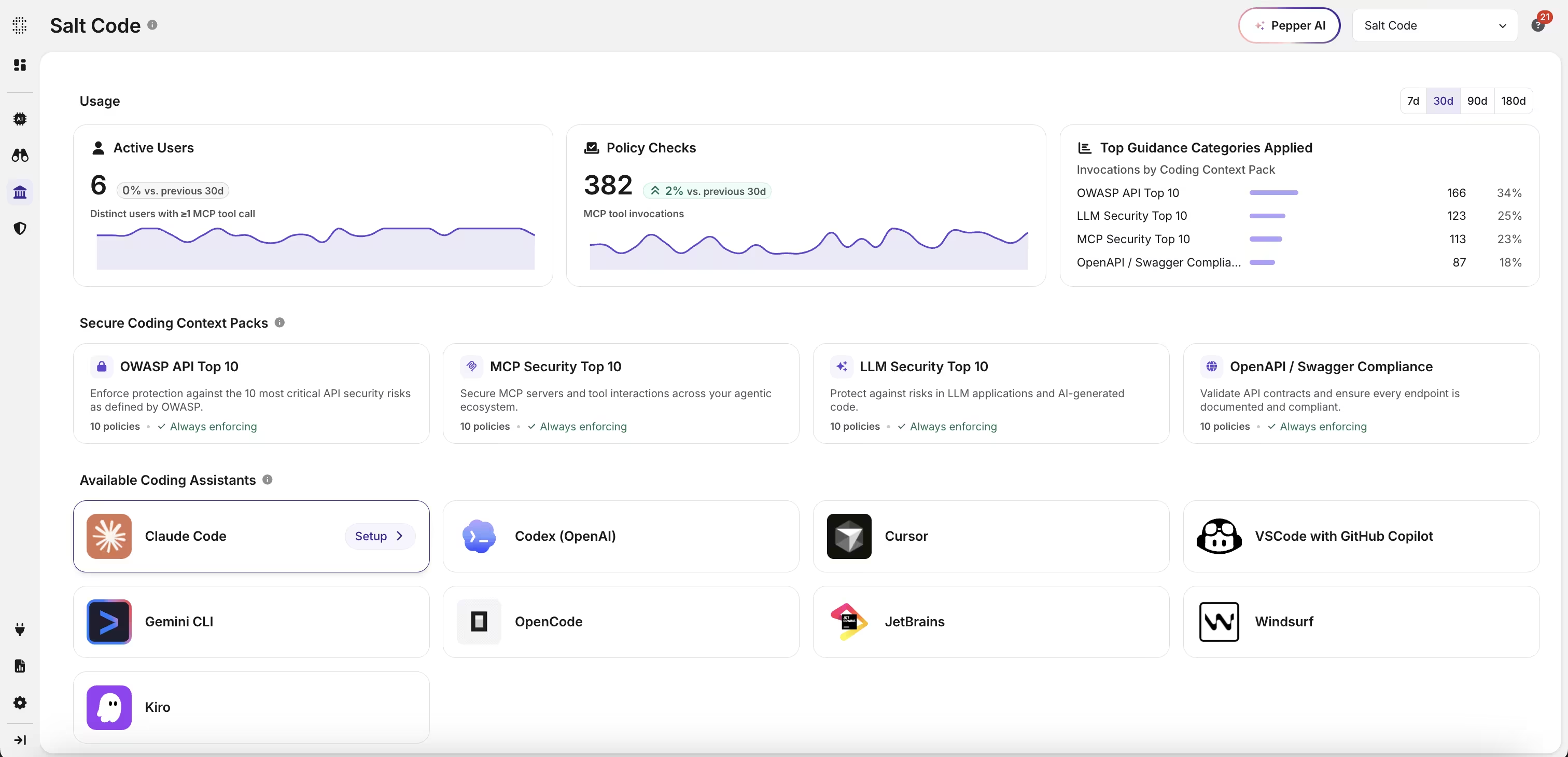
Integrations Works with every AI coding assistant in your stack.
Salt Code plugs into the tools your developers already use. If it supports MCP, Salt Code governs it.












Works with any AI coding assistant or code review workflow that supports MCP server configuration.
Why it matters Compliance becomes a property of the code itself.
Not a gate applied after the fact. Not a reviewer's checklist. Not a compliance audit ninety days later. Policy travels with the code from the first prompt forward.
01 Enforce your policies automatically
Internal security standards, industry best practices, and regulatory requirements applied to every line of AI-generated code. Without developer effort. Without security team intervention.
02 Prevent risk at the source
Vulnerabilities never enter your environment. The fastest fix is the one that never had to happen. The cheapest exploit is the one that was never written.
03 Cut developer friction and pipeline noise
SAST and DAST findings drop because the underlying issues stopped being created. Developers ship faster. Security reviewers stop drowning in tickets that should never have been opened.
04 One standard. Every developer.
Seasoned engineers and citizen developers produce code at the same security baseline. Vibe coders, agentic workflows, and overnight prototypes all answer to the same policies your enterprise expects.
AI is becoming the primary way software gets built.
Make sure every line of it follows your rules. Salt Code is available now.